

With “メトロ メロディー”, released on 6 February 2026, Club of Tone presents its first Japanese-language single. The song combines J-Pop songwriting and electronic production into a restrained crossover that focuses on timing, repetition, and shared everyday experience.
“メトロ メロディー” is written as a love declaration from a woman to the man she shares her daily commute with. Rather than presenting romance as escape or exception, the song places intimacy directly inside routine: morning trains, delayed schedules, platform sounds, and quiet proximity before work.
A J-Pop / Electronica crossover rooted in everyday urban life
The musical language of “メトロ メロディー” sits between contemporary Japanese pop and minimal electronic arrangement. The production avoids dramatic shifts or excess layers. Rhythm and pulse remain central, reflecting the mechanical repetition of city movement.
This approach mirrors the lyrical setting. Ticket gates, paper cups, blinking delay displays, tunnel reflections, door chimes, and subway wind are not decorative details. They form the structural environment in which the relationship exists. The city does not frame the story from the outside. It functions as its temporal system.
Lyrics as a female perspective on shared routine
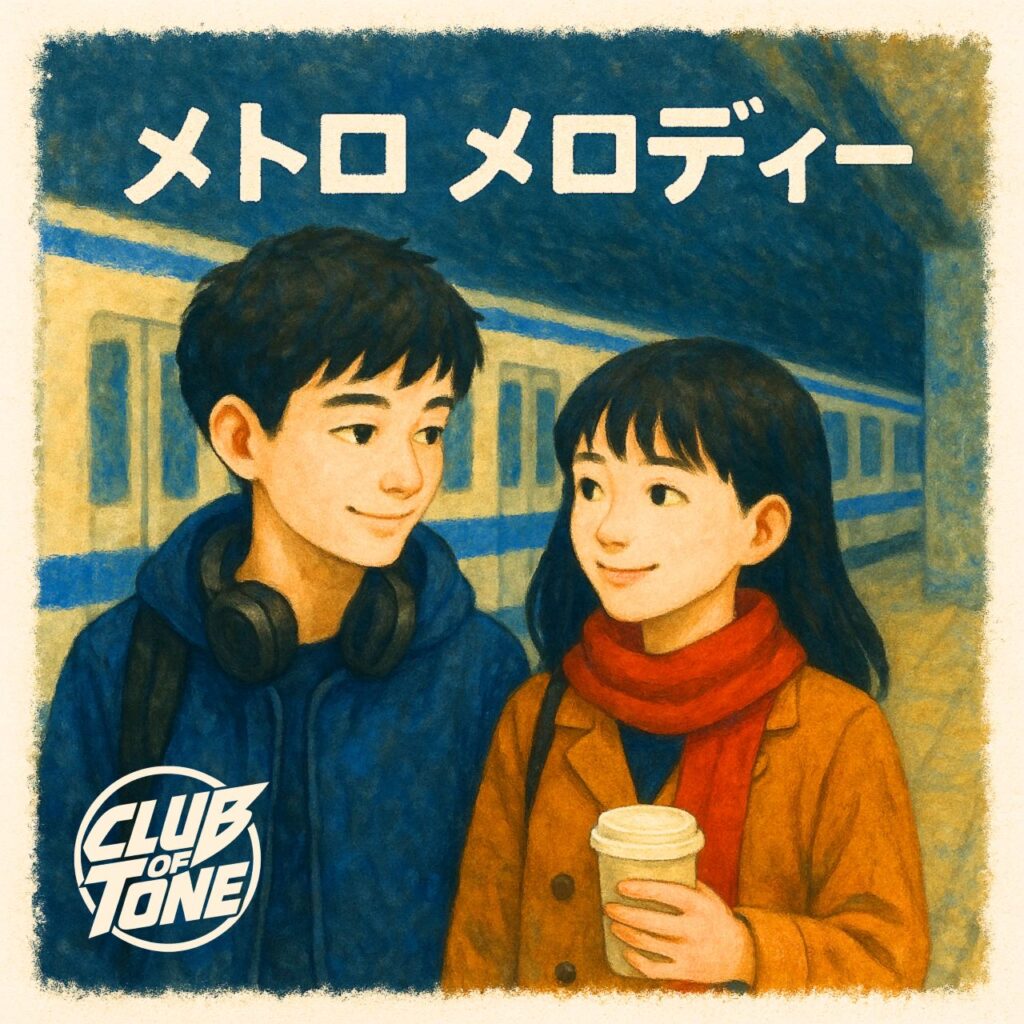
The lyrics are written from a female point of view, addressing a male partner through observation rather than direct declaration. Affection appears through attention to small moments: a sleepy greeting in front of the gates, steam from paper cups briefly merging, standing closer during delays.
Instead of metaphorical abstraction, the text treats sound as connective tissue. Sighs turn into rhythm. Heartbeats align with beats. Footsteps resemble percussion. Even a vibrating phone becomes part of the bassline. These moments do not interrupt routine. They redefine how it feels.
The repeated line “君となら、同じ9-to-5も歌になる” does not reject working life or daily obligation. It states that shared presence alters perception. The structure remains the same. The emotional weight changes.
Sound, counting, and pacing as relationship structure
Counting functions as a recurring motif. “Count one” and “count two” appear as quiet markers of connection, aligning human interaction with musical form. This reflects how closeness develops through pacing rather than intensity.
Waiting for the same train. Matching walking speed without comment. Getting off at the same station. These actions define the relationship more than explicit statements. The song’s steady rhythm mirrors this process.
The electronic elements reinforce the idea that music already exists inside repetition. Subway noise, wheel sounds, door signals, and platform ambience are treated as rhythmic components rather than interference.
Distance without rupture
The bridge introduces the possibility of divergence. Different lines. Detours. Separate mornings. Even here, the song avoids framing separation as loss. Memory and internalized rhythm maintain continuity.
The woman singing does not claim permanence. She acknowledges movement and change. What remains is the way the man’s presence has altered her internal timing. The melody continues, carried by remembered sound rather than proximity.
Why Japanese matters for “メトロ メロディー”
Choosing Japanese for this release was not a stylistic gesture. The language allows restraint without emotional absence. Meaning accumulates through context, repetition, and understatement rather than emphasis.
The use of 「君」 keeps the address intimate while avoiding unnecessary specification. The clarity of perspective comes not from grammar, but from the narrative position: a woman observing shared time with the man she loves.
The title reflects this balance. “メトロ” refers directly to infrastructure and daily movement. “メロディー” points toward continuity and emotional presence. Together, they describe a musical layer running parallel to routine life.
A first Japanese single as a quiet extension of Club of Tone
As Club of Tone’s first Japanese-language single, released on 6 February 2026, “メトロ メロディー” does not function as a manifesto. It opens space rather than closing definition.
The song shows how the project moves between languages and musical forms without altering its core approach: restraint in arrangement, attention to detail, and focus on shared experience.
“メトロ メロディー” is not about the city as spectacle. It is about the city as timing. And about how, within that timing, a woman hears her relationship with a man as a melody that briefly aligns with the rhythm of the subway.
“Metro Melody” – Full Lyrics
Translated from japanese by Thomas Alexander Kolbe
【Verse 1】
A sleepy “good morning” exchanged at the ticket gate
Steam rising from paper cups turns into our shared clouds
Even the delay board, even sighs, fall into rhythm
The moment we lean together, our heartbeat becomes the beat
【Pre‑Chorus】
Even the same scenery feels different with you
Humming adds color to the gray morning
The vibration in my pocket turns into a bassline
When our eyes meet, the count is one
【Chorus】
With you, the same 9-to-5 becomes a song
Rushing footsteps dance like a beat
Joy and worry, shared, are halved
Riding the subway wind, it’s our Metro Melody
【Post‑Chorus】
Metro Melody
Our Metro Melody
【Verse 2】
A tunnel brushes past the window, your profile reflected
Even the ad copy feels like an ally today
Between words, the wheels keep the hi-hat
I mark the rhythm in four beats with my fingertips
【Pre‑Chorus 2】
Amid the busyness, signals are left behind
The words “Are you okay?” start ringing in my chest
Hesitation overtaken before our stop
The door chime sounds, the count is two
【Chorus】
With you, the same 9-to-5 becomes a song
Rushing footsteps dance like a beat
Joy and worry, shared, are halved
Riding the subway wind, it’s our Metro Melody
【Bridge】
Even if a day comes when we take different lines
Your way of singing will surely not disappear
Detours at night, sunrise on the platform
The wind carries it all—our melody together
【Break】
La la la… Metro Melody
【Final Chorus】
With you, the same 9-to-5 becomes a song
Rushing footsteps dance like a beat
Joy and worry, shared, are halved
Riding the subway wind, it’s our Metro Melody
Riding the subway wind, it’s our Metro Melody